von ESK-Freiwillige | 14.09.2026 | Blog
Unsere Ehrenamtliche Maria schildert ihre Eindrücke von der internationalen Jugendbegegnung „Diverse Memories – Shared Future“.
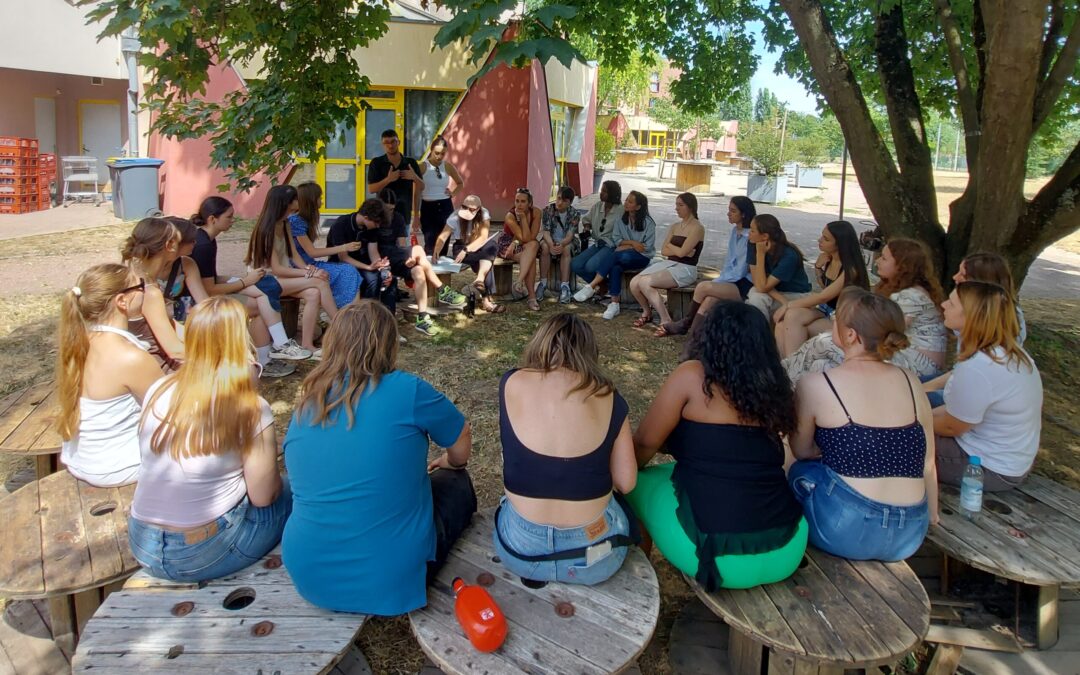
Zwischen dem 12.07. und 20.07. fand die Jugendbegegnung „Diverse Memories“ statt. Dabei kam es zu einem Zusammentreffen von jungen Leuten zwischen 16 und 22 Jahren, die aus Dresden, Straßburg oder Chmelnyzkyj kommen.
Die ersten Tage verbrachten wir in Straßburg, wo wir an vielen spannenden Aktivitäten teilgenommen haben, wie z. B. einer mehrstündigen Stadtführung und einem Comic-Workshop. Besonders die vielen Kennenlernspiele und „Energizer“ haben dazu geführt, dass das Eis schnell gebrochen wurde, sodass wir uns untereinander gut kennenlernen konnten und Freundschaften geschlossen haben. Nachhaltig in Erinnerungen bleiben die abendlichen Spaziergänge und die abwechslungsreichen Gespräche.
Nach vier Tagen ging es für uns nach Stuttgart. Dort haben wir uns intensiv mit den Erinnerungsorten und Denkmälern auseinandergesetzt, die an die NS-Zeit erinnern. Unter anderem haben wir gemeinsam mit Fridie, einer Mitarbeiterin des Stadtjugendrings, eine Gedenkstätte besucht. Des Weiteren haben wir in kleinen Gruppen ein Plakat zu einem Thema gestaltet, das uns am Herzen liegt. Die Aufgabe war es, dabei Ideen zu entwickeln, wie wir andere Leute darauf aufmerksam machen können. Von Statuen, Workshops, Aufklärungsarbeit und speziell angefertigten Kalendern war alles dabei. Natürlich blieb uns trotz der vielen Programmpunkten Zeit, um uns die lokalen Geschäfte anzuschauen, Museen zu besuchen und (sehr viele) Bilder zu machen.
Der Abschied am letzten Tag fiel uns allen schwer. Desto größer ist die Vorfreude auf den dritten und letzten Teil der Jugendbegegnung im Herbst, welcher in Dresden stattfinden wird.
Das Projekt wird durch das Deutsch-Französische Jugendwerk (DFJW) gefördert und im Rahmen von Erasmus+ von der Europäischen Union kofinanziert. 🇪🇺🤝
Es findet in Kooperation mit dem Stadtjugendring Stuttgart, dem Youth Council Khmelnytskyi und der Fédération du Bas-Rhin de la Ligue de l’Enseignement statt.
von Tobias | 27.11.2025 | Blog
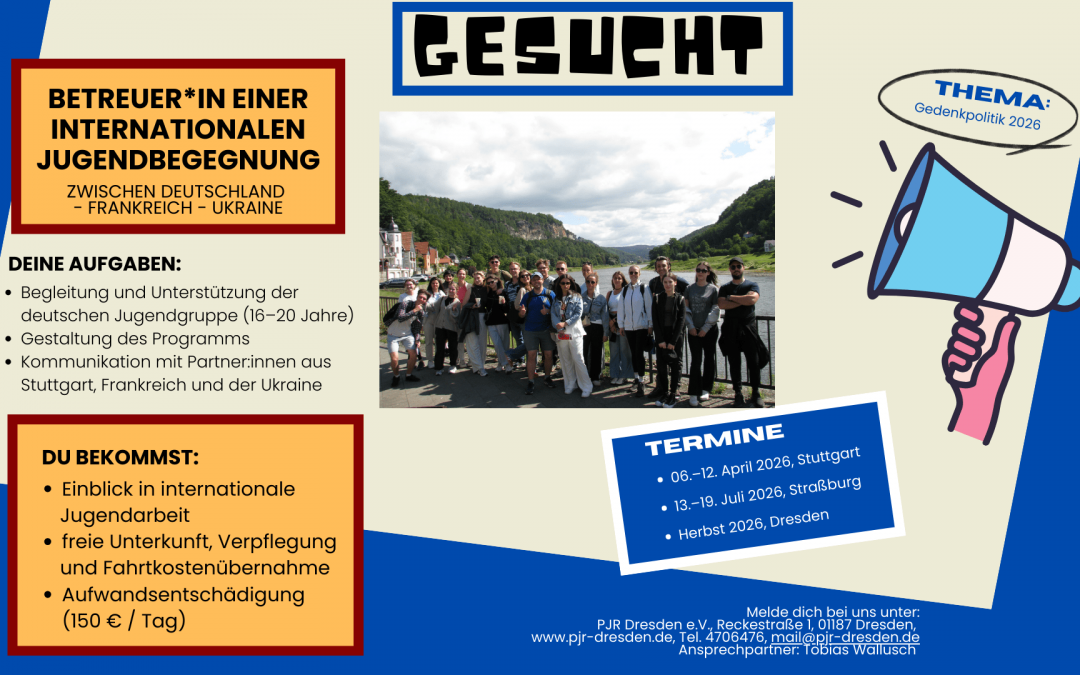
WIR SUCHEN eine/n ehrenamtliche/n Bertreuer/in für unsere Deutsch–Französisch–Ukrainische Jugendbegegnung zum Thema Erinnerungspolitik 2026 💭🌍
Das Projekt ist eine Kooperation des PJR Dresden und des Stadtjugendrings Stuttgart.
Im Mittelpunkt stehen die Fragen:
👉 Wie erinnern wir in Europa an Krieg, Diktatur und demokratische Neuanfänge?
👉 Wie können junge Menschen heute Erinnerungskultur mitgestalten?
📅 Voraussichtliche Termine:
📍 06.–12. April 2026, Stuttgart
📍 13.–19. Juli 2026, Straßburg (Frankreich)
📍 19.-25.10.2026, Dresden
✨ Deine Aufgaben:
• Begleitung & Unterstützung der deutschen Jugendgruppe (16–20 Jahre)
• Mithilfe bei Programmgestaltung & methodischer Umsetzung
• Organisation & Kommunikation mit Partnern aus Stuttgart, Frankreich & der Ukraine
• Unterstützung bei Freizeit, Gruppenprozessen & ggf. Übersetzung
💡 Wir wünschen uns:
• Interesse an politischer Bildung, Geschichte oder interkultureller Arbeit
• Freude an der Arbeit mit Jugendlichen
• Teamgeist, Geduld & Verantwortungsbewusstsein
• Englischkenntnisse (Französisch oder Ukrainisch sind selbstverständlich ein Plus)
🎁 Wir bieten:
• Einblick in internationale Jugendarbeit & Erasmus+
• freie Unterkunft, Verpflegung & Fahrtkostenübernahme
• Teilnahme an Vorbereitungstreffen
• ein Offizielles Zertifikat (Youthpass) über dein Engagement
• eine Aufwandsentschädigung von 150 € / Begegnungstag
📩 Interesse?
Dann melde dich beim Politischen Jugendring Dresden e. V.
✉️ mail@pjr-dresden.de
📞 0351 4706476
von ESK-Freiwillige | 17.02.2025
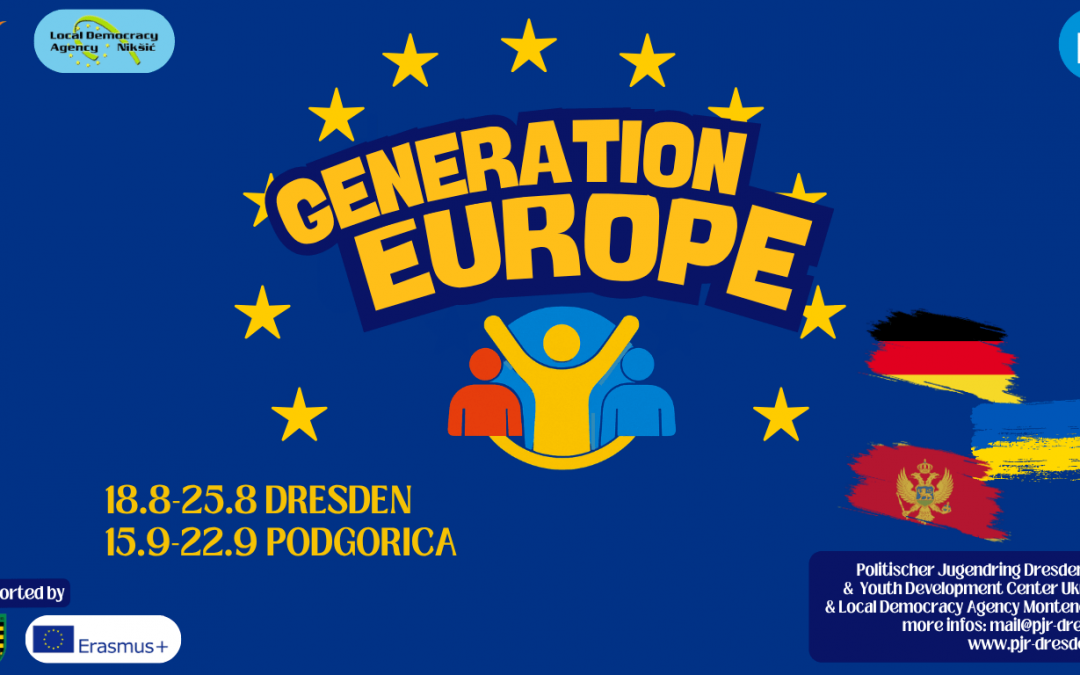
What does it mean to be European today? What values do we share and how does our origin shape our view of Europe? The ‘Generation Europe’ youth exchange programme brings together young adults from Germany, Montenegro and Ukraine to discuss personal identity, history and Europe’s future.
Part 1: Dresden (18-25 August 2025)
In Dresden, the focus will be on identity: Who am I in Europe? And how does the European project influence our idea of belonging? In interactive workshops and reflection sessions, we will examine our own origins and history, discuss national and European identity and exchange personal perspectives.
A particular focus will be on the question of what connects us in Europe beyond language, origin and political affiliation. Through group work, positioning games and a cooperative simulation game, the opportunities and challenges of cooperation between countries and cultures become clear.
Part 2: Podgorica (15-22 September 2025)
The exchange deepens in Montenegro. During city and embassy rallies in Podgorica and Cetinje, museum visits and debates with representatives of the government and civil society, Europe becomes a tangible experience. The participants reflect on the role that history, prejudices and political narratives play in European integration and what visions they themselves have for a Europe based on solidarity.
In a future workshop, the groups will design their own scenarios for Europe in 2050, discussing challenges such as nationalism, migration and geopolitical tensions and considering how young people can actively contribute to finding solutions.
Why take part?
🌍 Encounter & exchange with young people from three countries
🧭 Reflection on identity, values & the future of Europe
🎭 Creative formats, debates & workshops
🏛️ Experience culture, politics & history
📍 Dresden: 18-25 August 2025
📍 Podgorica: 15-22 September 2025
💶 Participation fee: €120 (incl. travel expenses, accommodation & meals)
🔗 To register: https://docs.google.com/forms/d/e/1FAIpQLSeiw-32ESdPTpZ6Gfa_Y1ctR5gRzLg6Dq8Qap6sh4Udayqo8Q/viewform
The participation in both activities is obligatory. Participation fee, which covers everything except insurance, for participants from Germany is 120 €, reduction for valid reasons can be disussed. The project is a cooperation between Politischer Jugendring Dresden e.V., Youth Development Center Ukraine and Local Democracy Agency Montenegro. The project is funded by the European Union and the State of Saxony.
von Freiwillige/r im Sozialen Jahr Politik | 20.06.2019 | Audio & Video
Hier ein Video von der Internationalen Begegnung in Terrassa, von einem unserer Teilnehmenden erstellt. Spaß gehört zu so einer Reise natürlich dazu 😉
von Freiwillige/r im Sozialen Jahr Politik | 16.11.2018 | Blog
When I started learning German, I had a vague dream of becoming fluent in a not so near future. I would read through my first texts trying to tell verbs from nouns and I would listen to helpful although not that informative recordings on how to say hello to strangers. That was more than six years ago, before I got to live in Leipzig for almost a year and made Berlin a sort of second home I always could come back to. I still have problems with some German words and I make tones of mistakes, but I would say I am nothing but proud of these misunderstandings and strange colocations: they mean that I can communicate in this beautiful yet challenging language.
There are a few language situations that make non-natives jump out of their skin and one of them is entering the unpredictable world of accents and dialects. Suddenly everything you though you knew about a language is not right anymore and you find yourself unable to tell the difference between simple words like yes or no. The comfort zone you carefully built around your abroad experience is shattered without a warning. This very safe space filled with common phrases and those idioms that took you so long to master does not seem to matter anymore.
Maybe I am getting a bit carried away by the language drama, but there is one universal truth to language learning: it is a process that involves vulnerability and being open to new things. I still remember my first conversation with a person who spoke Sächsisch, the traditional dialect of Saxony. I was two months’ shy from my intermediate German exam and I had trouble to understand what she shared with me about apple pie recipes and cold weather.
Since then I have encountered Sächsisch quite often, as I have almost only lived in Saxony: first two semesters in Leipzig, now my time as a volunteer in Dresden. I have even received a Sächsisch-Deutsch dictionary as a birthday present! Being the language nerd I am, it is no wonder that I decided to learn about the dialect in order to understand its particularities. Languages do not exist in a vacuum, they are an essential part of culture shaping and go beyond the narrow concept of speaking.

Saxony is located in the eastern part of Germany. In reality, that means a border with Poland and Czech Republic. For that reason, some words that exist in Sächsisch are actually closer to Czech and might be confusing for a non-native speaker like me. The first time I heard “nu” as a way to show agreement I thought that I had been caught in some intercultural lapse. It sounded like no, but it meant yes. Other singularities of Sächsisch have to do with phonetics, rendering conversations quite the challenge. I am fascinated by the transformation of voiceless consonants like K, T, P in voiced consonants like G, D, B.
Many questions I have about Sächsisch are somewhat related to the scientific and cultural difference between concepts like languages and dialects. There is no clear consensus on the topic, despite research and attempts to measure criteria like mutual intelligibility. Understanding languages and/or dialects as a phenomenon which deeply influences our perception of our social and cultural environment and our sense of self means adding another layer of complexity to the topic. I wonder how Sächsisch is seen in Saxony and in other German Bundesländer. I wonder why do people speak Sächsisch and how they feel about it.
I decide to leave my comfort zone of books about linguistics and to turn to the Internet. I have already asked German friends and colleagues about the perception of Sächsisch, as my interactions with people who actually speak the dialect are a bit limited. The answers are quite mixed, but they all point quite in the same direction: stereotypes and clichés about the dialect, German history and GDR times. In an article from Die Welt Fanny Jiménez writes about the cultural reasons behind the perception of Sächsisch and in Die Tageszeitung there is an interview with Annekatrin Michler about stereotypes around the dialect. She problematizes the differences between the two Germanys before the Einheit, explores the so-called Eastern Germany mentality and tries to find broader answers to these questions. She makes a point about German identity that should not go unnoticed. If we as a society are only able to perceive Eastern Germany as related to injustice, dictatorship, the Stasi (secret police during the GDR times), torture, violence and surveillance, we damage the concept of Eastern Germany and, by doing so, we also damage people´s identity. Another reason for this rejection of Sächsisch might have something to do with the bad experience many West Germans had when they visited the GDR, an image therefore imprinted on their minds.
Coming from Galicia, where both Galician and Spanish are spoken and there is still a lot of stigma around my mother tongue, I can not help but being very interested in these social topics. After exploring these bittersweet inputs, there is still room for something else. I would like to leave you with this interesting interview with the actor and cabaret artist Uwe Steimle, who shares some of his insights on the topic.
Der Europäische Freiwilligendienst wird durch Mittel von Erasmus+ finanziert.